Is Honkai: Nexus Anima PvP or PvE?
Honkai: Nexus Anima is mostly PvE, but it also has a ranked, seasonal Nexus Arena and friend duels. Here is how each side of the game works.
Honkai: Nexus Anima is mostly PvE, with a ranked PvP mode on the side. The game includes the Nexus Arena, a seasonal ranked mode with matchmaking and ranks from Retainer to King, plus duels with friends.
Almost everything else you play is against AI: story stages, wild Anima, Battle Experts around Iia and challenge modes like Path of Legends. The auto-chess combat borrows its look from games like Teamfight Tactics, but the structure underneath is a creature-collecting RPG.
Earlier versions of this page said there was no ranked ladder and no manual skill control. The game’s own rules text now describes both, so this guide has been rewritten around them.
Key takeaways
- PvE is the core. The campaign, open world and most modes are fought against AI-controlled teams.
- Ranked PvP exists. The Nexus Arena has matchmaking, seasons, Rank Points, seven ranks and an Arena Shop.
- You can pilot your skills. Arena skills are manual by default with an auto toggle; the opponent side is always automatic.
- Teams cap at 8 Anima, unlocked at player levels 10, 15 and 20.
- No shared shop, no shared unit pool. You bring a team you built outside the fight, which is the biggest difference from TFT.
Is there PvP in Honkai: Nexus Anima?
Yes, and more of it than the first beta suggested. PvP arrived in stages over the test cycles, and older coverage stopped at an early point in that history.
| Source | What it says |
|---|---|
| Wikipedia | Mode: “Single-player” |
| The Games Wiki | “The game is PVE-focused, with no competitive PVP mode.” |
| Nexus Bond Test (Sep 2025) | PvE only; no PvP mode in the build |
| Aspect Exploration Project (Apr 2026) | Added a basic direct-invite 1v1 mode, friends list only |
| Current in-game rules | Nexus Arena: ranked, seasonal, matchmaking, ranks Retainer to King |
The wiki entries predate the Arena, so “single-player” is out of date as a description of the mode list. It is still a fair description of where most of your hours go.
The game’s own pitch for the mode is direct: “Assemble your strongest team, face other players, and fight your way to the top of the Nexus Arena!” There are system messages for matchmaking errors and for a new season starting, so this is a built mode, not a placeholder.
How the Nexus Arena works
Everything in this section comes from the in-game Nexus Arena rules page. The rules do not say whether the opposing team is piloted live, and the opponent’s skills always fire automatically, so do not read it as a real-time duel.
Ranks and how many teams you field
There are seven ranks. Your rank decides how many teams you bring to each match:
| Rank | Teams per match |
|---|---|
| Retainer, Pawn | 1 |
| Knight, Bishop | 2 |
| Rook, Queen, King | 3 |
Each team needs at least one Eidos and one Anima, and no Eidos or Anima can sit on two teams in the same match. Each rank is split into divisions with their own promotion progress.
Before the match
You can see your opponent’s teams and positions before the fight, then use Adjust Team to swap members or reposition them. That makes the Arena a counter-building puzzle as much as a power check.
Your skills are activated manually by default, and you can switch them to automatic. The opponent’s skills are always automatic. Season Principles add effects to every battle for the whole season, and opponents at certain ranks get extra buffs, both of which you can check before you commit.
Scoring, Rank Points and protection
Each team fights one round, in sequence. In a three-team match, 3:0 or 2:1 is a win and 1:2 or 0:3 is a loss. Rank Points come from the overall result, not from each round.
- A win or draw in a match you start earns Rank Points; a loss costs them.
- The swing depends on both ranks, your opponent’s strength and, in three-team matches, the final score.
- From a two-win streak, wins grant bonus points. A loss or draw breaks the streak.
- Rank protection: once you reach a rank, losses cannot drop you below it, though your division can move.
- At King, the screen shows your percentile among that season’s players.
Arena Stars, rewards and seasons
Every match that ends normally pays Arena Stars, win, draw or loss, up to a weekly cap. Stars from other rewards do not count toward the cap. You spend them in the Arena Shop, which stays open after the season ends.
Each rank also has one-time rank-up rewards per season. When a season ends, your new starting rank is set by the division you finished in.
Do not quit mid-match. Leaving from the team or battle screen counts as a loss for the whole match, and rounds you already won are thrown out. A disconnect during battle lets you reconnect and keeps completed rounds; a disconnect during matchmaking means queueing again.
Friend duels
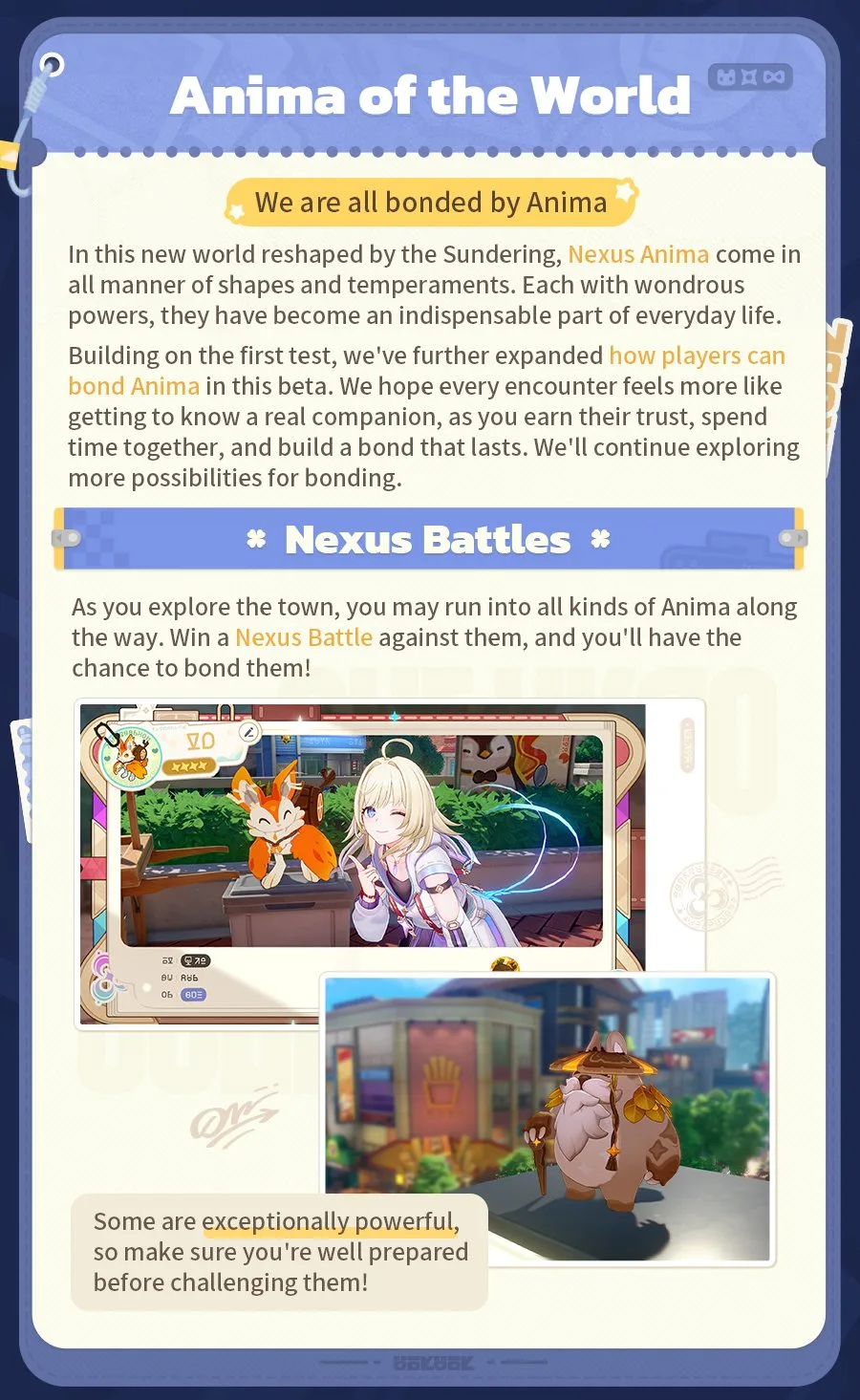
Separate from the Arena, you can challenge anyone on your friends list. The game’s tips put it simply: “Once you add friends, you can chat with them or challenge them to a Nexus Battle.” There is also a “Trial with Friends” label in the game.
This is the direct-invite mode that appeared in the Aspect Exploration Project. It carries no rank or rating, so it is the place to test a lineup against a specific person without risking points.
What PvE content exists
The PvE side is still where most of the game lives. It has three pillars.
Auto-chess battles against AI
You place up to 8 Anima on a hex board during the Preparation Phase, then the fight plays out in a Semiplane, a temporary pocket Plane the game says both sides’ Aspect energy creates. Anima move and attack on their own: each targets the nearest opponent in range, and Protectors are more likely to be targeted.
You are not just watching, though. Each Eidos builds Eidos Energy over time, and once it is full you drag or swipe to cast its Eidos Skill, or switch on auto-cast. Your own character can also deal damage directly in battle.
Open-world exploration
The game is set in Iia, a town on the continent of Lusciell in the Reality Plane. Lusciell is one of nine continents on that Plane, which is itself one of 81 Planes. You explore on foot, use Anima abilities to climb, glide and break walls, and Bond the wild Anima you defeat.
Some Anima appear only at night, and you switch between day and night by sitting on certain benches. The exploration guide covers the map district by district.
Challenge modes and side content
Path of Legends runs consecutive rounds with a Star Anima and Plot Twists. Thesophool’s Riddles is a floor-based challenge with stars per floor. Battle Experts are veteran duelists around Iia, and Work is Good and Material Stages spend Spirit for upgrade materials.
There are smaller modes too: Tower Defense, Renovation Battle, Furrari Express and a shop-management mode called Joyful Iia Once Again. See the Path of Legends guide for the biggest of these.
How PvE auto-chess differs from PvP auto-chess
This is where the confusion starts. Auto-chess as a genre was born from PvP (Dota Auto Chess, TFT, Hearthstone Battlegrounds), and Nexus Anima looks the part. But it swaps the competitive draft for RPG progression.
In TFT or Dota Auto Chess:
- You roll from a randomised shop that every player draws from
- Eight players compete for a limited pool of the same units
- Economy management (when to roll, when to level) is half the game
- Each match is a fresh start with zero carry-over
In Nexus Anima:
- You bring your own team of Anima that you collected and levelled outside the fight
- There is no randomised shop and no shared unit pool
- Your Anima keep their levels, Rapport and Dispositions between fights
- In PvE the goal is to clear a stage; in the Arena it is to win rounds with prepared teams
So even the ranked Arena is closer to a team-building contest than to TFT. You win by preparing the right counters and timing your Eidos Skills, not by outdrafting seven strangers.
Why PvE is still the core
HoYoverse’s big games (Genshin Impact, Honkai: Star Rail, Zenless Zone Zero) are all PvE-first, and Nexus Anima keeps that shape. The Arena sits next to the campaign rather than replacing it.
Gacha and PvP are an awkward mix. When players pay for pulls and those units fight each other, someone eventually loses to a unit they could have bought. The Arena rules do not mention stat normalisation, so how this is handled is not something the game answers.
Retention leans on content. The campaign, events and habitats carry most of the game’s progression. The Arena adds a weekly loop through Arena Stars and the Arena Shop, which is a reward track rather than the centre of the game.
The casual positioning. HoYoverse calls Nexus Anima a “companion-style experience.” The warm art and whimsical Anima (a seagull that carries you across the pier, a pudding puppy you use as a jump pad) still point at a low-pressure audience. Rank protection fits that: climbing is possible, falling back down is not.
The community PvP debate
On HoYoLAB, a popular post titled “Honkai Nexus Anima NEEDS PVP or it will FAIL” argued that auto-chess without player opponents goes stale. The r/HonkaiNexusAnima community was roughly split, between players who wanted competition and players who came for a calm PvE game.
The Arena answers the first group without forcing anything on the second. It is opt-in, it has its own shop, and nothing in the campaign requires it.
The open question has moved. It is no longer whether PvP exists, but how ranked play will treat gacha power. Season Principles and rank buffs give the developers levers to shape each season, and that is where the balance debate will land.
What the auto-chess battles play like
If you are coming from TFT, the honest answer is that it scratches a different itch, but it is still strategic.
Before each battle, you arrange your Anima on the board. Each Anima has one of five Traits (Blaster, Explorer, Mascot, Mastermind or Protector) that sets its combat role and where it wants to stand. Each also has an Aspect (Light, Dark, Competition, Memory and so on), and fielding enough of one Aspect triggers a Synergy Effect, stronger at higher levels.
The depth comes from balancing those two axes, then layering Eidos on top: each Eidos boosts specific Synergies and has an Anima Companion that gains an exclusive effect beside it. The formation guide breaks down rows, Traits and sample teams, and every Eidos page in the Eidos database lists its kit and companions.

FAQ
Is the Nexus Arena live against real players?
The mode’s description says you “face other players”, and it uses matchmaking. The rules also say your opponent’s skills are always automatic, so the opposing team is not piloted in real time the way your own skills can be. Treat it as ranked play against other players’ teams.
Is Nexus Anima pay-to-win?
In PvE, no: a strong 5-star makes stages faster, but you clear the same content either way. In the Arena, the rules do not say whether stats are normalised, so a fair answer has to wait for a full season of play.
What role do Eidos play in battle?
You deploy Eidos alongside your Anima before the fight. Each builds Eidos Energy on its own timer and casts an Eidos Skill when full, boosts one Aspect’s Synergy through its Aspect Skill, and powers up its Anima Companion. See the Eidos guide for the roster.
How do Anima rarities work?
Anima come in 3-star, 4-star and 5-star rarities. Higher rarity means stronger base stats and better kits. In PvE that lets you tackle harder content earlier; in the Arena it matters more, which is why the tier list is worth checking before you climb.
Bottom line
Honkai: Nexus Anima is a PvE creature-collector first, and that is where most of your time goes. But it is not PvP-free: the Nexus Arena is a full ranked mode with seasons, seven ranks, rank protection and its own shop, and you can duel friends without risking points.
If you want to climb, start by building two or three solid teams, since Knight and above ask for more than one. Browse the Anima dex and Eidos database for companions that fit, check the tier list, and plan your lineups in the team builder.
Frequently asked questions
- Is Honkai: Nexus Anima a PvP or PvE game?
- Mostly PvE, with a real PvP mode on the side. Story stages, open-world encounters, Battle Experts and challenge modes are all fought against AI teams. The game also includes the Nexus Arena, a ranked and seasonal mode where you "face other players" through matchmaking, plus friend duels.
- Does Honkai: Nexus Anima have ranked PvP?
- Yes. The Nexus Arena has matchmaking, seasons, Rank Points and seven ranks: Retainer, Pawn, Knight, Bishop, Rook, Queen and King. You field one team at Retainer and Pawn, two at Knight and Bishop, and three from Rook upward. Once you reach a rank, losses cannot demote you below it.
- Can you control skills in Nexus Arena PvP?
- Yes. The Arena rules say your skills are activated manually by default and you can switch to automatic activation. Your opponent's skills are always activated automatically. Outside the Arena, Eidos Skills are cast by dragging or swiping once Eidos Energy is full, with an auto-cast toggle.
- How many Anima can you field in a team?
- Up to 8. Team size rises to 6, 7 and 8 when your player level reaches 10, 15 and 20. One Path of Legends item adds one more slot, but only inside that mode.
- How is Nexus Anima different from TFT?
- In TFT you roll from a shared random shop and compete with seven players for the same units. In Nexus Anima you bring a team you collected and levelled outside the fight, so the challenge is preparation and formation rather than drafting. The Nexus Arena adds ranked play on top of that, but there is still no shared unit pool.
- Where can I learn how the auto-chess battles work?
- Read the formation guide for rows, Traits, Aspects and Synergy. The beginner progression guide covers the core loop and the first hours of play, and the tier list ranks which Anima perform best right now.