Honkai: Nexus Anima Bond Guide: How Bonding Works
How Bonding works in Honkai: Nexus Anima: winning a fight, Nexus Skeins, repeat Bonds into Energy and Rapport, plus Trust and Dispositions.
In Honkai: Nexus Anima, Bonding is how you catch an Anima: beat it in battle, throw a Nexus Skein, and on success it joins you. Bonding one you already own gives Energy for its Rapport ladder, and a separate Trust stat, raised with candies, drives its Dispositions.
That is a correction to how this guide first read. Written from the Evolution Test, it treated Bond as a relationship level that unlocks evolution. The game’s own rules text is clearer, and it splits the job across four systems. This guide walks through each one and where to spend your time.
This guide quotes the game’s own rules text and uses our own screenshots. Names, caps and rates can change between versions, and we update the page when they do.
Key takeaways
- A Bond is a catch. “The connection established with a Nexus Anima that allows you to summon and use it is known as a Bond.” You usually Bond after winning a fight.
- Skeins set your odds. The basic Nexus Skein has a low Bond rate. Blessed Skeins raise it, and some Skeins guarantee success.
- Duplicates become Energy. Repeat Bonds feed Rapport, a six-rank upgrade ladder per Anima.
- Nexus Energy Gathering targets Energy directly once you have Bonded an Anima three times.
- Trust and Dispositions are the relationship layer. Candies raise Trust (max 300), and Trust improves the Dispositions you roll.
- Evolution is separate. It runs on Evolution Challenges and an Evolith, not on a Bond level.
What a Bond actually is
The game’s own glossary entry is the cleanest definition: “The connection established with a Nexus Anima that allows you to summon and use it is known as a Bond. In most cases, you can Bond an Anima after defeating it in battle.”
So the order in the field is fight first, Bond second. A wild Anima you have not Bonded yet carries “a special mark over their heads” while you explore, which makes new catches easy to spot. Once a Bond succeeds, “You will immediately obtain an Anima”.
The same word names the gacha pull. Bond x1 and Bond x10 on the Eidos and Anima Standard Bonds are just another way to gain a unit. If you came for banners, currencies and pity, read the gacha guide.
Where you can Bond
The game tags each Anima with where it can be Bonded. The tags we found include:
| Source tag | What it means |
|---|---|
| Bond in Iia | Wild in the starting town and its districts |
| Bond in Habitats | Lives in a habitat you unlock and upgrade |
| Bond in Encounters | Comes from the Standard Bond banners |
| Bond in Ace Challenges | Bonded after beating a powerful roaming Anima |
| Bond in Evolution Challenges | Earned by evolving a juvenile |
| Bond in Path of Legends | Earned in the roguelike mode |
Some Anima can only be met in habitats, and Ace Challenges are where rarer Anima sit. Our exploration guide covers both, including Dawnstar Isle’s Ace Challenge.
Exploring is the front end of bonding: every wild Anima you beat is a chance to Bond it.

Nexus Skeins: how to raise your Bond chance
The item you throw is a Skein. The tutorial is short: “After winning a battle, use Nexus Skein to Bond the Anima”, and you drag it onto the Anima to start. Then the hints get specific:
- “The Nexus Skein has a low Bond rate. Try using the Blessed Skein for a higher chance of success!”
- “Blessed Skeins can significantly increase your Bond chance!”
- “Using rarer Nexus Skeins can improve the chances of successfully Bonding an Anima, and there are also Skeins that guarantee a successful Bond.”
- “Here, you can check the expected Bond chance for each Skein.”
That last line is the useful one. The game shows you the odds before you commit, so you do not have to guess whether a cheap Skein is worth a try. Skeins are sold from vending machines around town, which an NPC sums up as “For the town’s convenience, skeins are available in vending machines all over.”
When to spend a good Skein
Use the expected-chance readout to decide. A simple rule that holds up:
- New Anima you want: spend the better Skein. A failed Bond means fighting again.
- Duplicates for Energy: use basic Skeins. You already own the unit, so a miss costs little.
- Ace Challenge targets: bring a guaranteed Skein if you have one. These are the rare catches and the fights are the hardest to repeat.
No Bond rates are published, so we cannot give a percentage per Skein. Read the in-game panel.
Duplicates, Energy and Rapport
Bonding the same Anima again is not wasted. “Repeatedly Bonding will grant Energy for the corresponding Anima, which can be used to enhance Rapport.” The game also calls Energy “an effective way to boost their battle power”.
Rapport is that Anima’s upgrade ladder. Every Rapport track we have recorded has six ranks, mixing stat bumps with changes to the Anima’s skill, and the last rank often adds a new passive. Our Anima dex pages list the ladder per Anima. Puddlipup’s, for example, raises its Shield strength twice, adds Armor and MR, and finishes with a once-per-battle survival trigger.
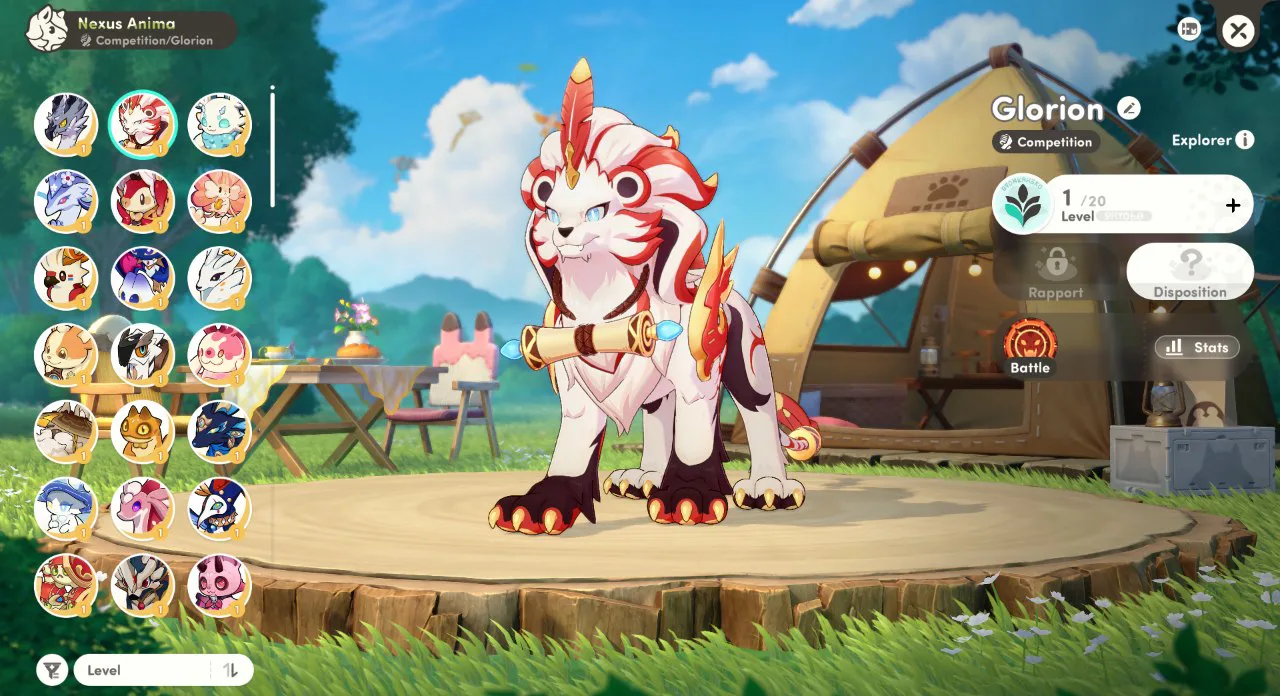
The Anima screen for Glorion, a Competition Explorer, with Rapport and Disposition slots beside its level.
Nexus Energy Gathering
Repeat catches in the wild are slow, so there is a stage built for Energy. The unlock rule: “Once you have bonded the same Anima 3 times while exploring, it becomes available to select in Nexus Energy Gathering.” You pick that Anima, and the stage pays its Energy.
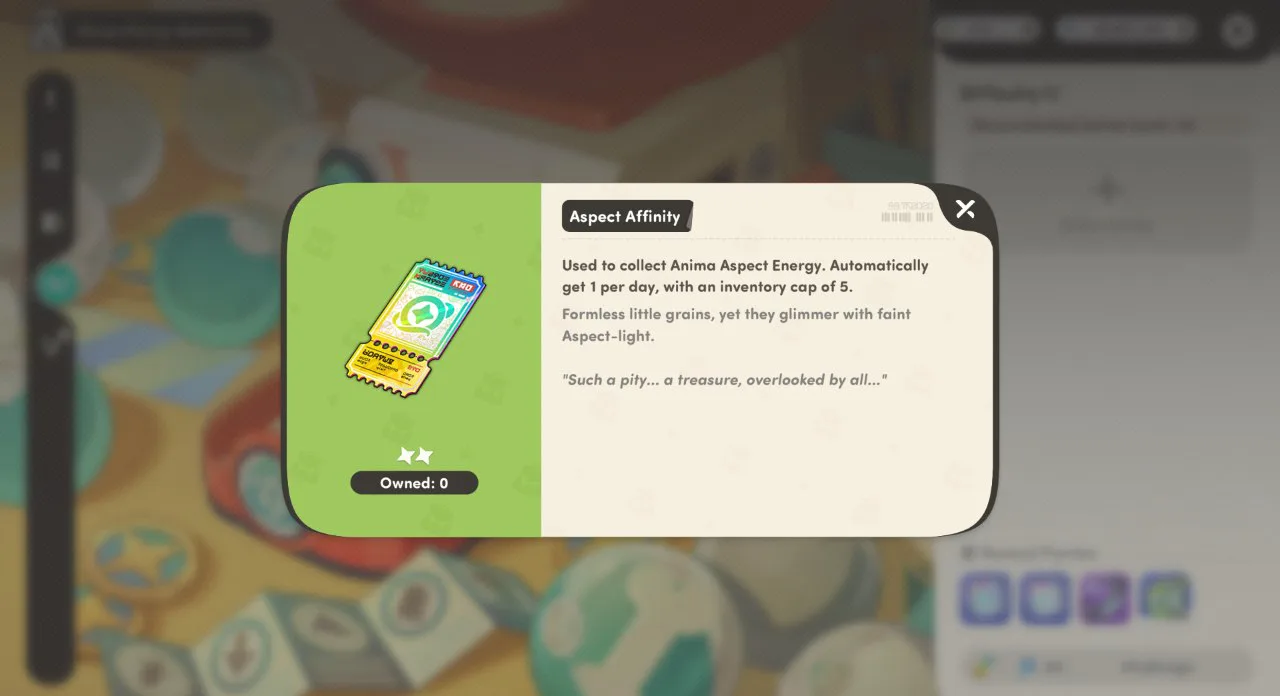
Each run costs an Aspect Affinity ticket. Its description reads “Used to collect Anima Aspect Energy. Automatically get 1 per day, with an inventory cap of 5.”
The Aspect Affinity ticket: one a day, five at most, spent on Nexus Energy Gathering.
The cap is the planning point. You can skip four days without loss, but a fifth idle day wastes a ticket. The game also warns when “This Anima already has all the Aspect Energy it needs”, so you cannot overfill one Anima by accident.
Trust and Dispositions: the relationship layer
If you were looking for a friendship stat, it is Trust. The rules:
- “Feed an Anima specific Disposition candies to increase its Trust.”
- “Trust is tracked separately for each Anima.”
- “An Anima’s Trust can reach a maximum of 300.”
- “The higher an Anima’s Trust, the greater the chance of obtaining high-quality Dispositions when feeding it specific candies.”
So Trust is not a power stat by itself. It improves your rolls on Dispositions, which are.
How Dispositions work
A Disposition is a pair of stat effects. The in-game rules, in order:
- “A Disposition consists of 2 Disposition effects.”
- “Each Anima can store up to 3 set of Dispositions”, and you can switch between them at any time.
- “Only 1 set of Disposition effects can be active at a time.”
- Dispositions of the same type vary in quality, and higher quality means bigger bonuses.
- “If the two effects in a Disposition have the same name, an additional bonus effect will be activated.”
You roll new ones by feeding candies, called Nexittles in one tutorial line, and each time you choose to save the new set over a stored one or discard it. The matched-pair bonus in rule 5 is the target, so keep feeding until a roll matches. Our Dispositions page lists every known effect, and note that most effect values there are recorded at level III.
Evolution is a separate track
This is the biggest change from our earlier write-up. Evolution does not wait on a Bond level. The game describes it as its own loop:
- “Complete Evolution Challenges to evolve juvenile Anima into powerful 5-star Anima.”
- You need the juvenile first: “Obtain the Anima’s juvenile form to unlock.”
- You need its Evolith: “Obtain the Anima’s Evolith to unlock”, and “Hold the Evolith to start Evolution”.
- Ace Challenges pay toward it: “Defeat opponents in the Ace Challenge to Bond rare Anima and earn Evolith Shards.”
The tutorial example is Umpurritty evolving into Umpurrella once its challenges are done. Bonding still matters here, because it is how you get the juvenile in the first place, but the gate is the challenge set and the Evolith. The evolution guide covers the step itself.
How to increase bond with an Anima
Players search for a bond level, and the game has none. No “Bond level”, “Bond rank” or “Bond evolution” exists in the strings. What it has instead is two separate meters, and growing an Anima means feeding both.
| What you want | The system that does it | What feeds it |
|---|---|---|
| More battle power | Nexus Rapport | That Anima’s Aspect Energy |
| Better Disposition rolls | Trust (max 300) | Disposition candies such as Fortune Candy |
| A new evolved form | Evolution | Evolution Challenges and an Evolith, not bond at all |
Raising Nexus Rapport
The Rapport screen calls the ladder Nexus Rapport, and the hint is direct: “Collect Aspect Energy to raise your Anima’s Nexus Rapport.” Each Anima has its own Energy item, described as “Energy that forms a certain Anima, used to upgrade its Rapport”.
You get that Energy three ways:
- Duplicate Bonds, in the field or from a banner.
- Nexus Energy Gathering, once you have Bonded the same Anima three times while exploring.
- Generic Energy items. The game lists “Energy of a certain 3 or 4-star Anima” and Random Aspect Energy, “Aspect Energy that forms an Anima yet to be determined”.
The ladder ends at a cap the game marks as “Nexus Rapport at Max Rank”, so once an Anima shows that, send your Energy elsewhere.
Raising Trust
Trust is the closest thing to affection. Feed the Anima Disposition candies and it climbs, up to 300, separately for each Anima. The candies named in the game include Fortune Candy (“Collect Fortune Candy for your Anima to eat and gain Dispositions”) and Potential-Awakening Candy. What each candy does beyond Dispositions is not described.
Gifts from Anima
There is one more sign of affection in the text. An Anima can approach you with “This Anima really likes you. Please accept its gift.”, with an Accept Gift button, and there are named prompts such as “Accept Bobabirb’s gift”. Some Anima also react to gifts, for example “The Apollinis likes this gift” and “The Rosfurcate is delighted with its gift”.
No rules text explains what triggers a gift, what it contains, or whether gifting raises Trust. We are leaving it at what the game says.
Bonding harder Anima in the first place
Bond difficulty is per species: “Each type of Anima has a different Bond difficulty.” Some gate on your own stats. The game says Plumelunes, often found in Central Park, “set the Charisma bar exceptionally high for anyone hoping to bond them”, and one townsperson adds that bonding takes “a high degree of affinity for the Aspect”. A Will to Cooperate label comes in Weak, Medium and Strong, which reads as the game’s own hint at how ready an Anima is to Bond, though no rule text defines it.
The Eidos side: Nexus Contracts
Eidos do not use Rapport. Their duplicate track is Eidothread, and the material for it is “Material for activating Nexus Contracts and upgrading Eidothread Ranks”. The game also has Form a Nexus Contract and Become Companion actions, and states that “Eidos provide enhancements to their corresponding Anima Companions”. Each Eidos page lists which Anima gain an exclusive effect from that Eidos.
Which Anima to invest in first
The resources are Skeins, Energy, Aspect Affinity tickets and candies. They all point at the same answer: spend on the Anima you field.
1. Your formation core
Team size is 6, 7 and 8 Anima at player levels 10, 15 and 20. Decide that lineup first with the formation guide and the Aspect synergy guide, then point Energy Gathering and candies at it.
2. Your milestone 5-stars
The Anima you pick at account Levels 18, 21 and 24 (see the reroll guide) are long-term anchors. They are the safest Rapport investment on the account.
3. Cheap Rapport on 3-star and 4-star units
The game lists a generic “Energy of a certain 3 or 4-star Anima, used to upgrade its Rapport”. Lower rarity units are also the easiest to catch repeatedly, so a 4-star at high Rapport can outperform a 5-star at none in the right Aspect team.
| Question about the Anima | If yes | If no |
|---|---|---|
| Is it in your active formation? | Energy Gathering and candies now | Next question |
| Is it a Level 18/21/24 pick? | Queue it for Rapport next | Next question |
| Does it fill an Aspect synergy gap? | Bond spares for Energy as you explore | Leave it on the bench |
A worked example
Say your Level 18 pick was Mesmerith, and you are building a Hate team around it. Once you have Bonded it three times in the field, it unlocks in Nexus Energy Gathering, and your daily Aspect Affinity ticket goes there until its Rapport is maxed.
Meanwhile, every duplicate Hate unit you catch while exploring is Energy for that unit, so you throw basic Skeins at those. Candies go to Mesmerith first, chasing a matched-pair Disposition, then to your main damage dealer. Check the board in the team builder before you commit, so the Energy lands on units that stay in the lineup.
Common bonding mistakes
- Treating Bond as a relationship level. It is a catch. Trust is the relationship stat.
- Letting Aspect Affinity sit at 5. Anything past the cap is lost.
- Spending good Skeins on duplicates. Save them for new or rare catches.
- Feeding candies to the bench. Disposition rolls are per Anima, so feed the units you field.
- Waiting on bonding to evolve. Evolution needs its own challenges and an Evolith.
Bottom line
Bonding in Honkai: Nexus Anima is the catch: win the fight, pick the right Skein, and the Anima is yours. From there, duplicates feed Rapport, Nexus Energy Gathering speeds that up, and candies build Trust and Dispositions. Point all of it at the team you actually field.
Next, set your lineup with the formation guide, see where Anima rank on the tier list, and read the beginner progression guide for how player level and Ascension fit around this loop.
Frequently asked questions
- What is bonding in Honkai: Nexus Anima?
- Bonding is how you obtain an Anima. The game defines a Bond as "the connection established with a Nexus Anima that allows you to summon and use it", and in most cases you Bond an Anima after defeating it in battle, using a Nexus Skein. It is the catch mechanic, not a friendship meter.
- What happens when you Bond an Anima you already have?
- You get Energy for that Anima. The game says repeatedly Bonding "will grant Energy for the corresponding Anima, which can be used to enhance Rapport". Rapport is a six-rank upgrade ladder per Anima, so duplicates are never wasted.
- How do you raise Bond chance in Honkai: Nexus Anima?
- Use a better Skein. The basic Nexus Skein has a low Bond rate, Blessed Skeins "significantly increase your Bond chance", and some Skeins guarantee a successful Bond. The game lets you check the expected Bond chance for each Skein before you throw it.
- What is Trust in Honkai: Nexus Anima?
- Trust is the per-Anima affection stat. You raise it by feeding an Anima Disposition candies, it caps at 300, and higher Trust raises the chance of high-quality Dispositions when you feed it. It is the closest thing the game has to a relationship level.
- Does bonding unlock evolution?
- Not directly. Evolution runs on Evolution Challenges and an item called an Evolith: you obtain the juvenile Anima, clear its Evolution Challenges, then hold the Evolith to evolve it. Bonding gets you the juvenile, and Ace Challenges pay Evolith Shards.
- How do you increase bond with an Anima in Honkai: Nexus Anima?
- There is no single bond meter. You grow an Anima on two tracks: Nexus Rapport, raised with that Anima's Aspect Energy from duplicate Bonds and Nexus Energy Gathering, and Trust, raised by feeding it Disposition candies up to 300. An Anima that really likes you may also offer you a gift.