Honkai: Nexus Anima Beginner Progression Guide
Beginner roadmap for Honkai: Nexus Anima: player level and Ascension Quests, team size unlocks, Anima Ascension, Rapport, Spirit and what to spend first.
Honkai: Nexus Anima beginner progression runs on your player level: it unlocks team slots at Lv. 10, 15 and 20, gates you behind Ascension Quests at Lv. 20, 30 and 40, and drags your bonded Anima levels up with it. Your real choices are which Anima to Ascend and where your Spirit goes.
It is a creature collector with an auto-chess battle system. You catch Anima across the Planes, then place them on a hex board where they fight on their own according to their Trait (combat role) and Aspect (synergy identity). This guide walks the first hours in the order the game unlocks them.
This guide quotes the game’s own rules text and uses our own screenshots. Numbers and names can change between versions, and we update the page when they do.
Key takeaways
- Player level is the spine. It rises from quests, exploration, new Bonds, the Journey Guide, Daily Activity, Battle Experts and Work is Good.
- Team size grows to 8. You get 6, 7 and 8 slots at player levels 10, 15 and 20.
- Anima level with you. Level Resonance raises bonded Anima levels with your player level, so materials go into Ascension, not experience.
- Spirit runs the material grind. It refills 1 point every 6 minutes up to a cap of 300 and is spent on Material Stages.
- Duplicates feed Rapport. Repeat Bonds give an Anima Energy, and Energy upgrades its Rapport.
- Commit to one Aspect. Synergy is the biggest lever on a formation, so build one team fully before starting a second.
How to play Honkai: Nexus Anima: the core loop
The loop has four steps: create your character, explore Iia and Bond wild Anima, win Nexus Battles with them, then spend what you earn on your team. Here is each step as the game’s own tutorials describe it.
Create your character
You start by choosing a body type and a name (no spaces or special characters). Your character also has three attributes, Strength (STR), Intelligence (INT) and Charisma (CHA), and the game says “many dialogue options will only be unlocked when you satisfy the Attribute requirements”. Some Anima react to them too: Eggnok will not fight you if your STR is too low.
Attribute points can be reallocated later with a Protean Pill, sold at the Echo Pawnshop and the Globe-Trotter Store. Your character’s power of Change also lets you rename yourself later. Who your character is, and their own battle kit, is covered in our characters guide.
Explore and Bond wild Anima
“In most cases, you can Bond an Anima after defeating it in battle.” After you win, you use a Nexus Skein to attempt the Bond. Each Anima has its own Bond difficulty, rarer Skeins improve the odds, and some Skeins guarantee success.
Catch three of the same Anima and the game unlocks quick acquisition for it, so you can farm that species without hunting it down each time. The exploration guide maps where Anima live, including the ones that only come out at night.
Fight Nexus Battles
You deploy your team during the Preparation Phase, then the fight moves into a Semiplane, a temporary pocket Plane. Each Anima has its own attack range (drag it across the board to see it), walks toward the nearest opponent if nothing is in range, and attacks the nearest one if several are.
Your part during the fight is your Eidos. Each Eidos builds Eidos Energy on its own timer; when it is full, drag or swipe to cast its Eidos Skill, or switch on automatic casting. Boss opponents have Tenacity, which damage and Control Effects wear down; at zero the boss becomes unable to act.
Grow your account
Battles, quests and exploration raise your player level, which is the spine of everything below. The rest of this guide walks those systems in the order they unlock.
The menu: where each system lives
The main menu is a grid of eight tiles on its first page: Guidebook, Evolution, Tutorials, Anidex, Items, Crafting, Quests and UtopIia, the in-game social feed where players share Chromatic Anima sightings. The profile card beside it shows your player level and your Nexus Level.
The main menu. The profile card shows player Lv. 60 at max level next to Nexus Level 4.
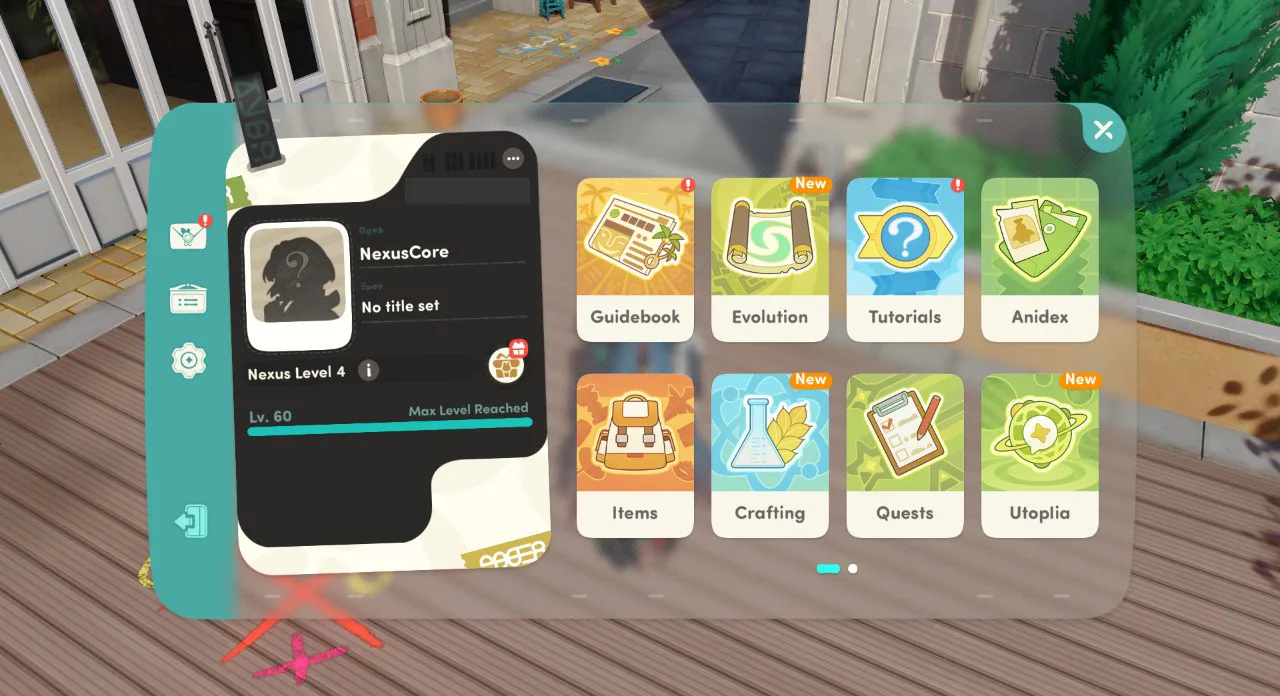
Three of these tiles are worth opening early:
- Tutorials keeps every pop-up explanation you have seen, which helps when a system’s rules scrolled past during a fight.
- Anidex records “the Anima you have encountered and Bonded”, and filling it pays master rewards. It is a checklist and a reward track at once.
- Evolution is where you take a juvenile Anima through its Evolution Challenge. Our evolution guide covers it in full.
Player level, Nexus Level and Ascension Quests
Your account has a player level, and Experience is what moves it. The game lists six sources:
- Complete quests
- Explore the world and Bond new Anima
- Complete the Journey Guide
- Complete Daily Activity
- Challenge Battle Experts
- Clear Work is Good
The second one matters most for a new account. Every new Anima you Bond is Experience as well as a new unit, so catching broadly while you explore is never wasted time.
Ascension Quests at Lv. 20, 30 and 40
Levelling is not continuous. The rule text reads: “When you reach Lv. 20/30/40, you must complete an Ascension Quest before you can level up further.” The game names four of them, Ascension Quest I to IV, and uses them as unlock gates, for example “Reach Lv. 20 and complete Ascension Quest I to unlock”.
The same text links your level to how the world treats you: “As your Nexus Level rises, opponents grow stronger and rewards grow richer.” Our profile at Lv. 60, “Max Level Reached”, showed Nexus Level 4. Our reading is that Nexus Level counts the Ascension tiers you have cleared, but the game does not spell that out.
Team size and Level Resonance
Two rules sit on a single help page, and together they shape the whole early game:
| Player level | Team size |
|---|---|
| 10 | 6 |
| 15 | 7 |
| 20 | 8 |
Level Resonance is the second rule: “The levels of bonded Anima increase in tandem with your player level.” This is the biggest difference from most collectors. You do not feed experience to each creature one at a time, so a newly caught Anima is not dead weight on the bench. The usual collector advice to level one carry first does not apply here in the same way.
Anima Ascension and Crafting
If levels follow you, the thing you invest in is Ascension. The game describes it plainly: “Ascension raises an Anima’s level cap and all of its Base Stats.” Ascension materials come from the Anima Ascension Material Stage, and they are used “in every phase of Anima Ascension”.
Materials are split by Trait. In the Crafting screen, for example, Sturdy Shield is described as “Common material for Protector Anima Ascension”, and the material grid shows a separate family per Trait, each in several rarities. Crafting converts lower materials into higher ones, so a surplus of one tier is not wasted.
The Crafting screen, showing Sturdy Shield, the common Ascension material for Protector Anima.
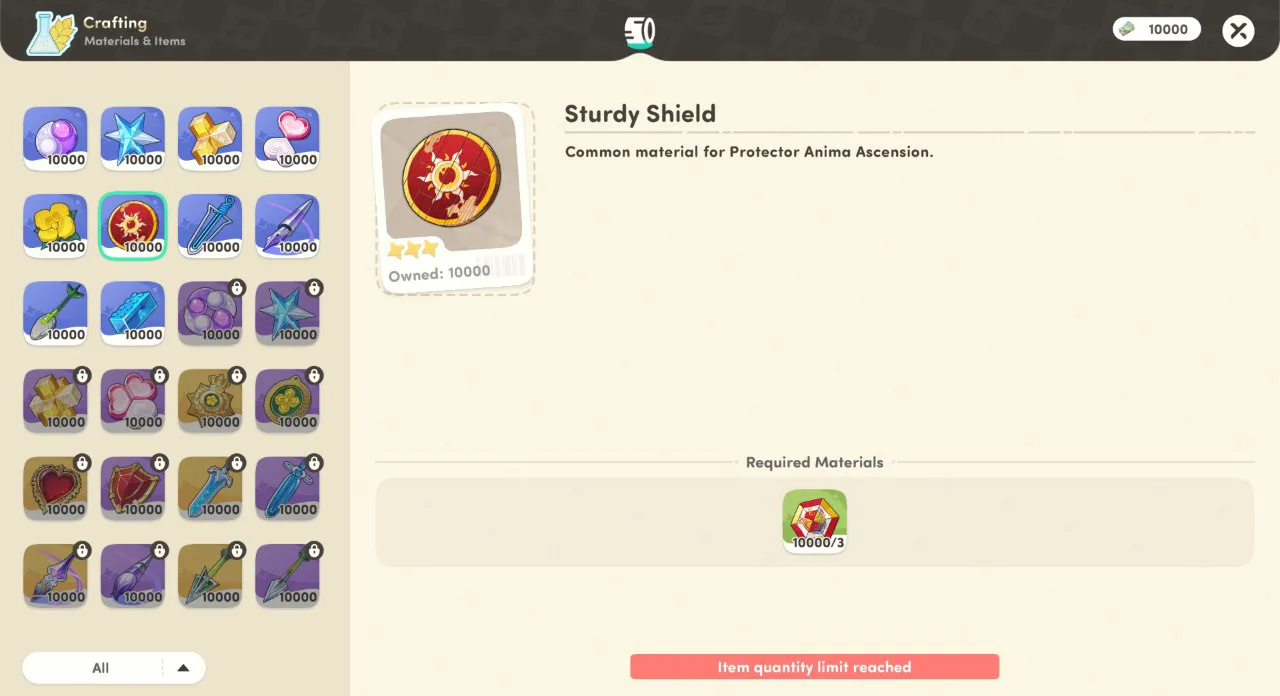
The practical upshot is that your Trait mix decides your material bill. A team with two Protectors needs twice the Protector line. Settle your formation before you start Ascending, or you will farm materials for a unit you bench.
Spirit and Material Stages
Spirit is the stamina that pays for Material Stages. The rules are short:
- Spirit regenerates 1 point every 6 minutes, which is 240 a day.
- The maximum is 300, and it stops regenerating once full, so an empty bar takes 30 hours to fill. Logging in once a day keeps you from wasting any.
- You can exchange Aspect Gems for Spirit, which is rarely a good trade early on.
- Higher difficulties unlock as your Nexus Level rises and drop more, better materials.
- Clearing a difficulty once unlocks consecutive battles at that difficulty, so you can repeat it without setting up each run.
Eidos have their own Material Stages too: the game names Eidognosis Ascension Materials and Eidognosis Comprehension Materials for the Eidos node tree.
Duplicates, Energy and Rapport
Catching or pulling an Anima you already own is not wasted. In the game’s words: “Repeatedly Bonding will grant Energy for the corresponding Anima, which can be used to enhance Rapport.” Rapport is the Anima’s rank ladder. It is the creature equivalent of Eidothread for Eidos, and the game calls it “an effective way to boost their battle power”.
Nexus Energy Gathering
You do not have to rely on lucky repeat catches. Nexus Energy Gathering is a stage that pays Energy for a chosen Anima directly. It unlocks per Anima: “Once you have bonded the same Anima 3 times while exploring, it becomes available to select in Nexus Energy Gathering.”
Each attempt costs one Aspect Affinity ticket. The ticket description reads “Automatically get 1 per day, with an inventory cap of 5”, so you can skip up to four days without losing any. The stage has difficulties I to V, each with a recommended Anima level, and Difficulty IV recommended level 48 when we checked.
Nexus Energy Gathering at Difficulty IV. You pick the Anima, spend an Aspect Affinity ticket, and the stage pays that Anima’s Energy.
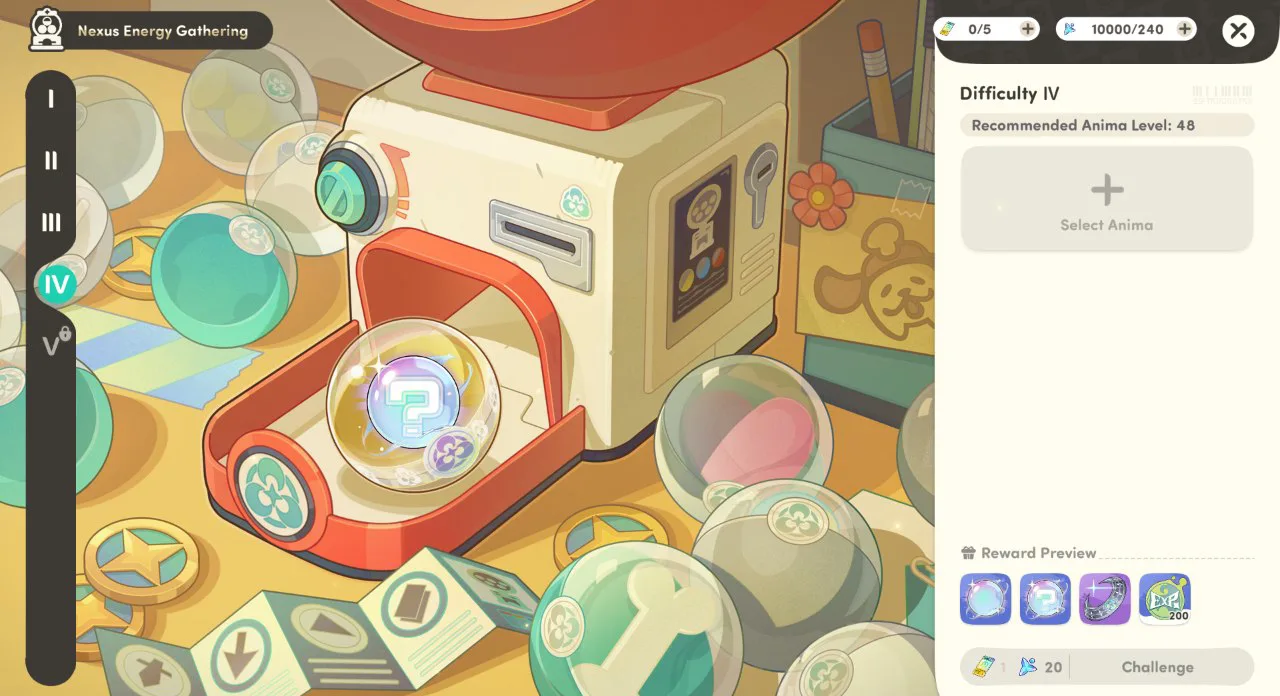
The game also lists a generic item, “Energy of a certain 3 or 4-star Anima, used to upgrade its Rapport”. That suggests lower-rarity Rapport is cheaper to fill, which matches the general rule that 3-star and 4-star units want their copies stacked. See our bond guide for the full Energy and Rapport loop.
Build your first team: Traits and Aspects
Your formation needs a mix of roles. There are five Traits:
- Blaster (13 Anima): area damage, damage over time and crowd control. Scales on attack power.
- Explorer (22 Anima): the deepest role. Aspect bonuses treat it as offensive in some cases and durable in others.
- Mascot (13 Anima): scales on Max Health alongside Protector, so it holds a position.
- Mastermind (16 Anima): traps, summons and buffs that control the field. Scales on MP.
- Protector (18 Anima): the tank. The game confirms that “Anima with the Protector Trait are more likely to be targeted.”
Targeting is simple: when several opponents are in range, an Anima “will prioritize attacking the nearest one”. That is why a Protector in front changes what the enemy backline hits.
Synergy decides more than rarity
Fielding enough Anima of one Aspect triggers a Synergy Effect, and “higher Synergy level grants stronger effects”. Your Eidos then amplifies units that share its Aspect. A board of mixed 3, 4 and 5-star units on one Aspect usually beats a scattered board of 5-stars. Check the Aspect synergy guide, then try the board in the formation planner before you spend materials.
A simple early shape for six slots: two damage dealers (Blaster or an offensive Explorer), one Protector, one Mastermind for control, and two flexible slots filled by whatever completes your Aspect count.
What to spend first
This is the order we would follow on a fresh account:
- Push player level to 20. Team size reaches 8 and Ascension Quest I opens. Everything else scales off this.
- Spend Spirit every day. Capped Spirit is lost Spirit. Point it at the Ascension materials for the Traits your main team uses.
- Ascend your core team, not your bench. Level Resonance keeps the bench levelled for free; Ascension is where materials are scarce.
- Use Aspect Affinity before it caps at 5. Put it into Rapport for your main damage dealer first.
- Fill the Anidex as you go. New Bonds give Experience, Anidex rewards and, after three catches, an Energy Gathering target.
- Hold Aspect Gems. The Level 18, 21 and 24 milestone 5-star picks in our reroll guide beat gacha pulls, and the gacha guide covers the 50-Bond Eidos guarantee and the monthly pass.
- Clear Weekly Guild Tasks. They level the free row of Guild Boost, the battle pass, by up to 10 levels a week. Our battle pass guide covers both paid tiers.
What we cannot confirm yet
- The starting team size. Only the 6, 7 and 8 steps are stated.
- What Nexus Level measures exactly. Our profile showed Nexus Level 4 at player Lv. 60.
- Material drop rates. Material Stage rewards scale with difficulty, but no table is published.
Bottom line
Progression in Honkai: Nexus Anima is less of a grind per creature than most collectors. Player level carries your Anima with it, so the scarce resources are Ascension materials, Spirit and Rapport Energy. Spend all three on one Aspect-focused team.
Next steps: browse the Anima dex to see which Trait each Anima belongs to, check the tier list for the community read on early carries, and look at the Eidos database to pick the character whose Aspect your team will follow.
Frequently asked questions
- How do you level up fast in Honkai: Nexus Anima?
- The game lists six Experience sources: quests, exploring and Bonding new Anima, the Journey Guide, Daily Activity, Battle Experts, and Work is Good. Bonding new Anima counts, so catching widely while you explore levels you as well as your roster.
- What are Ascension Quests in Honkai: Nexus Anima?
- Level gates on your player level. At Lv. 20, 30 and 40 you must finish an Ascension Quest before you can keep levelling, and the game numbers them Ascension Quest I to IV. Several features are locked behind them, for example "Reach Lv. 20 and complete Ascension Quest I to unlock".
- How many Anima can you field in Honkai: Nexus Anima?
- It grows with your player level. The game says your team size rises to 6, 7 and 8 at player levels 10, 15 and 20, so the board fills out in your first few hours.
- Do you need to level every Anima separately?
- Not in the usual way. A rule called Level Resonance makes the levels of bonded Anima rise with your player level. What you do spend materials on is Anima Ascension, which raises an Anima level cap and all of its Base Stats.
- What is Spirit used for in Honkai: Nexus Anima?
- Spirit is the stamina currency for Material Stages, which drop Anima and Eidos development resources. It regenerates 1 point every 6 minutes up to a maximum of 300, and can be topped up with Aspect Gems.